Are there giant ants in outer space? How is DNA crammed into the cell nucleus? How many Starbucks stores are there in Seattle? Can you extract information from a black hole?
Hey Students! Thank you for sending in your logo design ideas! We’ll be reviewing all art submissions and contacting the designer of the winning logo by early September, 2026!

Physics provides a powerful set of tools for understanding the world around us and answering remarkably diverse questions like the ones above. UBC Physics Circle invites motivated high school students (grades 10–12) to join us as we build up this toolkit, and apply it to everything from buying a cup of coffee to the deepest mysteries of the cosmos. Our main goal is to foster curiosity, creativity, and a sense of community.
*Physics Circle sessions run from October to April*
April 2026: Thank you students for joining us for this year’s cycle of fantastic Physics exploration! We are always honoured to meet curious, upcoming and future physicists. We loved your questions, your engagement with the content and participation with your peers. We hope to see you next year in Fall 2026 with our keen undergraduate organizers and next year’s line-up of UBC researchers. – Physics Circle organizers.
Physics Circle 2026 Fall meetings will begin on October 14th, 2026 with biweekly sessions consisting of 2-hour sessions on Wednesdays for both Term 1 (September – December) and Term 2 (January – April) from 5:00–7:00 PM. We will be meeting in HEBB 316. For the list of this year’s dates, please see below.
We strongly encourage students underrepresented in STEM – girls, Indigenous youth, and those from underprivileged communities – to participate.
Please email physics.circle@phas.ubc.ca if you have any questions.
*This event is free for any high school student who wishes to participate. We look forward to meeting you!

Features
- Meetings start with lectures. Typically, a UBC physicist or astronomer will introduce their research, more advanced physics concepts, some applications of physics, or ideally all three (5:00–5:45).
- After the lecture, students are let loose on an auxiliary discussion topic or problem set (5:45–7:00). This is an informal setting where students can explore, ask questions, and learn actively together. We commonly make explorations beyond the high school syllabus, but the technical scope is limited to suit most backgrounds.
- Physics Circle volunteers facilitate discussions and provide guidance, as well as hold occasional problem-solving tutorials.
Topics and Resources of our next Cycle
2026-2027 Physics Circle Schedule
See below for our 2026-2027 Schedule.
*Note: we have special events happening throughout the academic year on the following dates to which you are invited – please check our Events Page for more details*:
- 2026.10.07: Science Slam I: all high school students invited to attend! On UBC-V campus
- 2026.11.18: Undergrad Career Night: all high school students invited to attend! On UBC-V campus
- 2027.02.10: Science Slam II: all high school students invited to attend! On UBC-V campus
*Problem sets and solutions will be added either before, or on the day of the lectures*
- 2026.10.14 Welcome to Physics Circle! Discussion [TBD], with Thomas Rennie (PHAS post-doc).
- 2026.10.28 Discussion “Standard Model of Particle Physics“, with Josephine Brewster & Meghan Naar (PHAS graduate students).
- 2026.11.25 Discussion [TBD] with Mark Van Raamsdonk, PHAS faculty.
- 2026.12.09 Discussion [TBD] with Valery Milner, PHAS faculty.
- 2027.01.13 Discussion [TBD], speaker Janis McKenna, PHAS faculty.
- 2027.01.27 Discussion “Detecting dark matter deep underground using ultra-cold crystals“, with Sukeerthi Dharani (PHAS post-doc).
- 2027.02.24 Discussion “MRI: Mighty Rad Imaging” with speakers Tigris Joseph and Adam Suban-Loewen.
- 2027.03.10 Discussion [TBD], with Hrishabh Srivastava (PHAS graduate student).
- 2027.03.31 Discussion on “Single-molecule microscopy“, with Cindy Shaheen (Michael Smith Laboratories – Leslie Lab post-doc).
- 2027.04.07 A Double Bill! Two mini-lectures with PHAS Undergrads Hawk Zhang and Aidan Lytton! Stay tuned for topics!
Topics and Problems from Past Cycles
2025-2026
2025.10.08 Welcome to Physics Circle! Discussion, “Radiation for good? Using photons in medicine to investigate the unseen“, by PHAS Graduate students Mitchell Halajian and Elys Jamieson. Question set + answers here.
2025.10.22 Discussion, “A general introduction to Radio Astronomy“, by PHAS Post-doc Thomas J Rennie. Question set here. Solutions here. Join via zoom.
2025.11.05 Discussion, “The Clustering of Galaxies“, by PHAS Graduate students Joey Bhangal and Anan Lu. Question set here. Solutions here.
2025.11.19 Discussion, “Physics Testing Strategies“, by PHAS lecturer Andrzej Kotlicki. Question set here. Solutions here.
2025.12.03 Discussion “Following Muons into the Dark :ATLAS and the search for hidden particles”, by PHAS Graduate student Khurshid Usmanov. Question set here. Solutions here.
2026.01.14 Discussion, “From Birds to Bees to Pterodactyls: The Physics of Animal Flight“, by PHAS faculty Scott Oser. Question set here. Solutions here.
2026.01.28 Discussion, “How to build an MRI machine and why you might want to”, by PHAS faculty Carl Michal. Question set here. Solutions here.
2026.02.11 Discussion, “Superconductivity“, by PHAS faculty Alannah Hallas. Question set here.
2026.02.25 Discussion, “How to guess the answers: ‘bootstrapping’ physics“, by PHAS PhD student Jonah Berean-Dutcher. Question set + solutions here.
2026.03.11 Discussion, “Spectroscopy with short laser pulses“, by Quantum Matter Institute (QMI) Post-doc Christina Hofer. Question set here and solutions here.
20264.04.01 Discussion, “Cosmology and gravity“, by PHAS faculty Mark Halpern. Question set here and solutions here.
Thank you students for joining us for this year’s cycle of fantastic Physics exploration! We are always honoured to meet the curious, upcoming and future physicists. We loved your questions, your engagement with the content and participation with your peers. We hope to see you next year in Fall 2026 with our keen undergraduate organizers and next year’s line-up of UBC researchers. – Physics Circle organizers.
2024-2025
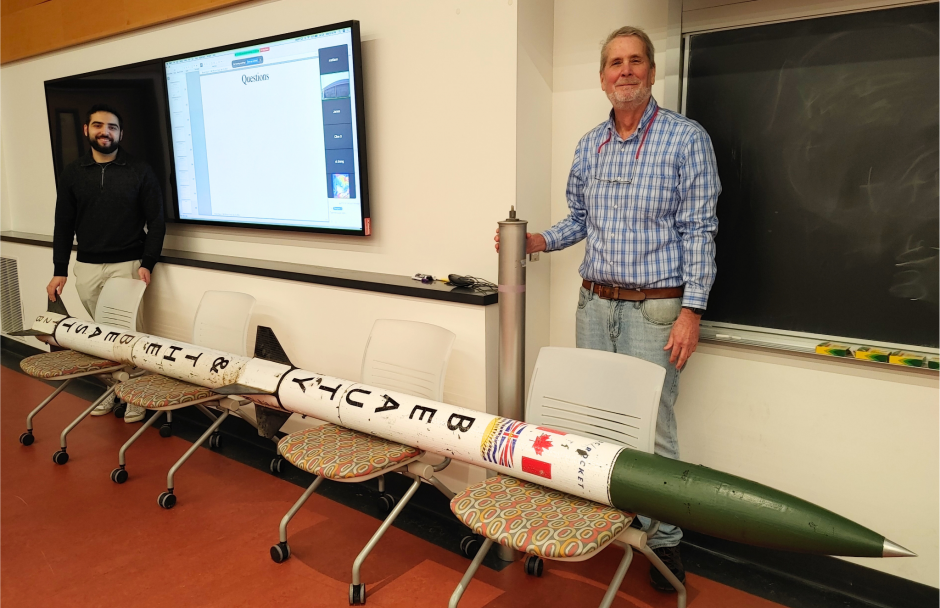
- 2025.04.02 – LAST SESSION! – Discussion, “UBC Rocket: A Student-Led Mission to 30,000 Feet“, with Alexis Hilts and the UBC Rocket Club!Tour included. Zoom link here. Slides here. Problem set 1 and solutions, by Alexis Hilts.
- 2025.03.12 Discussion, “Building a Human-Powered Submarine“, with Caleb Lowe and the UBC Submarine Design Team (SUBC)! In-class demo, and problem set and solutions by Sam McInnis and Alexis Hilts. Zoom link here.
- 2025.02.26 Discussion, “A Planet Hunter’s Guide to the Galaxy” with Dr. Michelle Kunimoto, PHAS faculty. Zoom link here. Problem set 1, and solutions by Micah Piva and Debo Biswas.
- 2025.02.12 Discussion, “Big Numbers in the Universe” with Dr. Douglas Scott, PHAS faculty. Zoom link here. Problem set will be posted after the session.
- 2025.01.29 Discussion, “Single-molecule studies of structural changes in twisted DNA” with Dr. Cindy Shaheen, postdoctoral researcher at the Leslie Lab (housed in the Michael Smith Labs). Problem set 1 and solutions by Alexis Hilts. Get ready for our Kahoot trivia quiz! Zoom link here.
- 2025.01.15 Discussion, “The Most Successful Model in Particle Physics (and why physicists want another)” with Ryan Quinn, PhD candidate working with the ATLAS Experiment. Problem set 1 and Problem set 1 solutions by Alexis Hilts, Deboyoti Biswas and Neil Jadav.
- 2024.12.04 This is our last session for 2024! Discussion “Crystal Clear: making Sense of the Structure of Matter“, with Dr. Allanah Hallas PHAS faculty; Blusson Quantum Matter Institute researcher with the Hallas Lab. Problem set 1 and Problem set 1 solutions by Debo Biswas and Neil Jadav. Zoom link. There will be a Kahoot session as well, today!
- 2024.11.20 Discussion, “Calcium Signals: the Currency of Cell Physiology” with Dr. Nicola Fameli, Biophysicist, PHAS lecturer. Problem set 1 and Problem set 1 solutions by Neil Jadav and Alexis Hilts. Zoom link.
- 2024.11.06 Discussion, “An Amateur’s Guide to String Theory” with Dr. Sean McBride, PHAS Post-doctoral Research Fellow. Problem set 1 and Problem set 1 solutions, by Neil Jadav and Airene Ahuja. View the slides: “An Amateur’s Guide to String Theory“.
- 2024.10.23 Discussion, “Radio Foregrounds: Studying the Galaxy to Remove It” with Dr. Thomas Rennie, PHAS Post-doctoral Research Fellow. Problem set 1 and Problem set 1 solutions, by Dr. Thomas Rennie. Zoom link / passcode: 217982.
- 2024.10.16 Physics Circle Welcome! Discussion, “Molecular Dreidels: Spinning Molecules with a Laser Beam“, with Dr. Valery Milner PHAS faculty. Problem set 1 and Problem set 1 solutions by Deboyoti Biswas and Sam McInnis. Zoom link / passcode: 707993.
2023-2024
2022-2023
2022.11.02 Physics Circle program Welcome! Meet new members and Physics Circle volunteers and enjoy a problem-solving session with relativity questions!
2022.11.16 With Physics & Astronomy Professor Dr. Allison Man; Discussion: “An Exercise in Basic Astronomy” (slide and solutions) by Aakash Anantharaman
2023.02.16 “ATLAS experiment at CERN”, by Dr. Alison Lister
2023.03.09 “DNA Biophysics”, by Cindy Shaheen; Discussion: “DNA Biophysics” (slide and solutions) by Cindy Shaheen
2023.03.23 “Connecting Physics Across all Scales – the Renormalization Group”, by Gaurav Tenkila
2023.04.06 “Optics & Lasers”, by Dr. Valery Milner
2021-2022
2021.10.28 Physics Circle program introductions and solving general physics problems. Speaker materials: Solving General Physics Problems
2021.11.18 Speaker materials: “Quantum gravity, or how to make black holes with microscopes” by Dr. David Wakeham; Discussion: Dimensional Analysis (& solutions) by Diego Araujo
2021.12.02 “Single-molecule insights for drug discovery and development: the next level of resolution” by Dr. Sabrina Leslie
2022.01.27 “What do condensed matter physicists do” by Dr. Mona Berciu; Discussion: The Physics of Snowmageddon by Rio Weil
2022.02.10 With Physics & Astronomy Professor Dr. Jess McIver; Discussion: A Tale of Two Black Holes by Alice Xiong
2022.03.03 With Physics & Astronomy Professor Dr. Douglas Scott
2022.03.17 With Engineering Physics Project Lab Director Dylan Gunn
2022.03.31 With Physics & Astronomy Professor Dr. Alannah Hallas
2020-2021
2020.10.15 Nobel physics prize special — black holes and general relativity. Dr. David Wakeham. Speaker materials: The Penrose Singularity Theorem | Problems
2020.10.29 Gases and molecular view of temperature. Dr. Mark Van Raamsdonk
2020.11.12 Pseudo-vectors and rotation in higher dimensions. Dr. Joanna Karczmarek; Discussion: Stern-Gerlach Experiment | Solutions
2020.11.26 Magnetic resonance imaging (MRI). Dr. Alex MacKay; Discussion: Introduction to MRI
2020.12.10 Quantum information. Dr. Robert Raussendorf; Discussion: Qubits and Quantum Gates
2021.01.14 Physics of rocketry. UBC Rocket Design Team. Speaker material: The Rocket Equation; Discussion: Simulating a Paper Airplane
2021.01.28 Fourier Transforms Ketty Na; Discussion: Symmetry in Electromagnetism | Solutions
2021.02.11 The Remarkable Life of Galaxies Dr. Allison Man; Discussion: HR Diagrams | Solutions
2021.02.25 Medical Physics Dr. Stefan Reinsburg. Speaker materials: What can Physicists Do for Health?; Discussion: Special Relativity I
2021.03.11 Unsolved Problems in Physics Alex May. Speaker materials: Open Ended Problems | Solutions
2021.03.25 Colors Pedram Amani. Speaker materials: Presentation slides
2019-2020
What is Hawking radiation? Douglas Scott | Hawking radiation and evaporating black holes (solutions included)
Lab tour at Stuart Blusson Quantum Matter Institute. Pinder Dosanjh | Energy, entropy and magnets (solutions)
Rainbows (solutions). Pedram Amani | Optical principles and phenomena (solutions)
The space weather of ultracool dwarfs. Anna Hughes | Detecting exoplanets and binary stars (solutions)
What do condensed matter physicists do? Mona Berciu | Collisions and electricity (solutions)
Astronomy. Deborah Good | Signals from aliens
Gravitational waves. Jess McIver | Colliding black holes
Quantum computing. SBQMI: Diversifying Talent in Quantum Computing (DTQC)
Particle physics and the Standard Model. Robin Hayes
2018-2019
Astronomy and astrophysics. Jaymie Matthews | Problem set (solutions)
Music and physics. Chris Waltham | Problem set (solutions)
Quantum mechanics. Mark Van Raamsdonk | Problem set (solutions)
Cosmology. Douglas Scott | Problem set (solutions)
Exploring the nano-universe. Gary Tom | Problem set (solutions)
Early days with quantum tasks. Alex May | Problem set (solutions)
Astronomy and astrophysics. Christa Van Laerhoven | Problem set (solutions)
Dimensional analysis. David Wakeham | Problem set (solutions)
Dark matter and neural nets. Lucas Bezerra | Problem set
Fermi problems. David Wakeham | Problem set
2017-2018
Astronomy and astrophysics. Mark Halpern | Problem set (solutions)
ATLAS experiment at CERN. Alison Lister | Problem set (solutions)
Low and high dimensions. Joanna Karczmarek | Problem set (solutions)
Molecular dreidels: Spinning molecules with a laser beam. Valery Milner | Problem set (solutions)
Optics lab: Geometrical optics phenomena. Joss Ives
Condensed matter. Ian Affleck | Problem set (solutions)
Medical physics. Alex MacKay | Problem set
Thank you speakers!
We are grateful to past and present Physics Circle speakers for sharing their time and efforts to bring challenging and exciting science to high school students. Physics Circle relies on faculty, grad students and post-docs for providing mini-lectures and demonstrations that bring physics alive to students.
Our Volunteers
2025-2026: Alexis Hilts and Micah Piva (Program Coordinators); Angela Man, Debojyoti Biswas, Elena Timakova, Josephine Brewster, Megar Naar, Mehar Sahota, Neil Jadav, Sam McInnis, Sebastian Poutt and Taiki Shikele.
2024-2025: Caleb Lowe and Debojyoti Biswas (Program Coordinators); Micah Piva, Neil Jadav, Danielle Egilson, Adrian Gus, Airene Ahuja, Zachary Mitchell, Sam McInnis and Alexis Hilts.
2023-2024: Sean Ghaeli (Program Coordinator); Micah Piva, Debojyoti Biswas, Danielle Egilson.
2022 – 2023: Peter Yazdi, Aakash Anantharaman, Nicholas Rees, Alice Xiong
2021 – 2022: Arnab Adhikary (Program Coordinator 2021–22), Pedram Amani, Morgan Arnold, Jocelyn Baker, Anneke den Breejen, Kara Deane, Amritabha Guha, Candice Ip, Diego Araujo Najera, Cindy Shaheen, Joshua Tindall, Luke Vance, Chris Waddell, David Wakeham, Ashley Warner, Rio Weil (program coordinator 2020–22), Alice Xiong (Program Coordinator 2020–22)
Past volunteers: Hailey Ahn, Connor Bevington, Philip Bement, Mariposa Casida, Sean Chen, Sean Ghaeli, Peter Gysbers, Andy Hsu, Daniel Korchinski, Pedram Laghaei, Tiffany Matthe, Marianne Moore, Ennio Moreau, Grace Zhang